
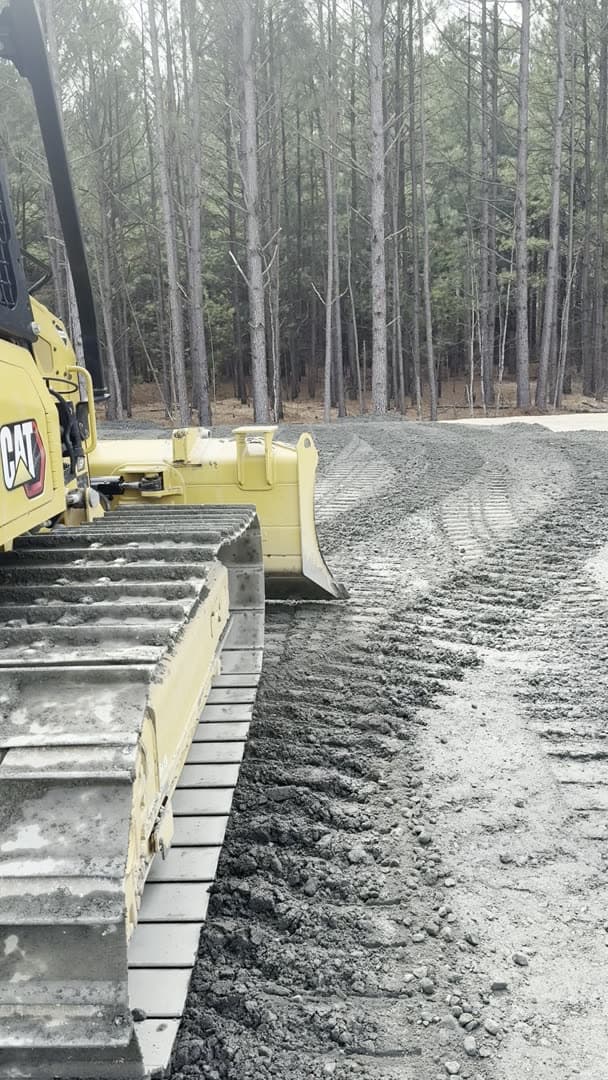
"Affordable" means different things to different property owners. For the retiree clearing two acres behind a Whiteville homestead to build a shop, affordable might mean the work fits a five-figure budget and the debris goes away without a second call to a hauling service. For a Columbus County farmer clearing a field edge for equipment access, affordable means the stumps are ground flush enough that a bush hog will not catch them. For a developer preparing a parcel along NC-130, affordable means the price per acre lines up with what the project math allows.
This post is about what land clearing actually costs in the Whiteville and Columbus County market — and why the cheapest quote on your property is almost always the expensive one by the time the job is finished.
What "affordable" actually means for local clearing
Most residential and small-commercial land clearing in Columbus County runs between $1,500 and $4,500 per acre. Smaller, denser, or harder-to-access jobs land at the top of that range. Open fields with scattered scrub pine land at the bottom. The full national range on clearing prices goes higher — up to around $6,000 per acre for heavy hardwood bottoms with haul-off disposal — but most of what we do locally falls inside the narrower window.
The range is wide even on "simple" jobs because the variables are large. Pine stand you can walk through costs one number. A tangle of sweetgum and brier that has not been touched in twenty years costs a different number entirely, even on the same property. Disposal changes the math again: mulching the debris in place is the cheapest path, pushing and piling for later burning sits in the middle, and hauling debris off-site to a compost or land-clearing landfill is the most expensive option.
A typical job at Ward looks like this: two to six acres, mixed pine and hardwood on ground that drains reasonably well, debris either mulched or pushed into a burn pile the owner handles after the site dries out. Those jobs usually quote within the $1,500 to $3,000 per-acre band. Our land clearing service page lays out the methods in more detail.
Why the cheapest quote is usually the expensive one
A cheap clearing quote almost always reflects a shortcut somewhere, and the shortcut becomes the property owner's problem after the crew leaves.
Uninsured work is the most common one. A contractor with no general liability coverage and no workers' comp can underbid a properly insured contractor by a meaningful margin — until something goes wrong. If a tree lands on a neighbor's fence, a chainsaw injures a crew member, or a tracked machine cracks a septic drain line, the liability falls on the landowner. A few hundred dollars saved on the quote is not close to what a claim costs out of pocket.
Debris disposal is the second corner that cheap quotes cut. If the quote says "debris removed" but does not specify where, ask. Debris dumped illegally in a woodline, burned without a permit in a county that requires one, or left in piles the owner gets to deal with later are all common outcomes. The cost does not disappear — it moves onto the property owner's side of the ledger.
Equipment and stump-depth shortcuts show up later. An undersized skid steer through heavy hardwood takes three times as long as a proper forestry mulcher, and the difference shows up as site damage — ruts, compaction, torn-up topsoil — or unfinished work. Stumps ground to six inches below grade look clean on completion, but if the contractor was behind schedule and left them at two inches, the settling shows up a year later when the soil compacts around them, usually right under a new driveway or slab.
Permit research is the last one. Land-clearing in North Carolina has a one-acre threshold for state erosion and sediment control rules, and several coastal and wetland-adjacent situations trigger additional requirements. A contractor who does not ask about it is leaving the fine exposure with the property owner.
How Ward keeps clearing affordable without cutting corners
We own the equipment. Every machine on a Ward job is ours — tracked excavators, forestry mulchers, dozers, haul trucks. When a contractor rents equipment, the rental rate is baked into the quote with a markup. When the equipment is paid for, that markup goes away.
We are local. Our yard is on Old Tram Road in Whiteville. Mobilization to a Whiteville or Columbus County job is a short trip. Mobilization to Brunswick, Bladen, or Robeson County is a reasonable trip. Drive time is built into quotes — the shorter the drive, the cheaper the quote. Contractors based an hour away are paying crews to sit in trucks twice a day, and that shows up in the number you get.
We recommend the method that actually fits the site. Forestry mulching is cheaper than push-and-pile on most moderately wooded ground because there is no burn pile to manage and no hauling to arrange. Push-and-pile is cheaper than mulching when the property has a lot of large hardwood that mulches slowly. Selective clearing and grubbing are cheaper than either when only specific material needs to come out. We recommend the method that fits your site, not the one with the highest margin for us.
We scope honestly during the estimate. If we walk the property and see conditions that change the job — a wet spot that will need matting, an access issue, underground utilities where the owner expected none — we say so before we give the number. That way the quote you get is the quote you pay. Revised quotes mid-job are how jobs go over budget.
What to expect from a Ward quote
The estimate is free and it happens on your property. We will not quote land clearing over the phone without seeing the site — not because we are being difficult, but because a phone quote is a guess, and a guess either comes in high (to protect us from surprises) or low (and gets revised upward once we see the actual conditions). Neither one is what you want.
The quote is written. You get the acreage, the method, the disposal plan, the timeline, and the total. If the scope changes during the walk-through — you decide to add a half-acre, or you want the stumps removed instead of ground — we adjust the number before we send it.
We do not upsell. If your two-acre job needs push-and-pile with a 300-series excavator and a D5 dozer, that is what is quoted. We will not write in a forestry mulcher that costs more and does not fit the site. We will not pad the acreage because round numbers quote better. If the job is 1.6 acres, the quote says 1.6 acres.
The timeline has weather built in. Columbus County weather affects clearing work — saturated ground takes equipment longer, wet stumps burn worse, rain stops mulching. The timeline in the quote reflects a realistic work window, not a best-case scenario.
Is clearing cheaper in winter or summer?
Winter work is often cheaper for two reasons. The ground is firmer — less rutting, less matting, less time lost to mud — and demand is lower, with contractors booking out further in spring and summer. A January or February clearing job in Columbus County often quotes 10 to 20 percent below the same job in May.
Winter has trade-offs: burn permits are sometimes easier to secure, but short daylight and occasional frozen ground can slow work. On balance, if the schedule allows, clearing in the slower months saves real money.
Can I keep the wood or timber to offset the cost?
On most small residential clearing jobs, the answer is no. The merchantable value of timber from a one-to-five acre lot is usually less than the cost of separating, staging, and hauling the logs to a mill. On a mixed brush-and-scrub site, it almost never pencils out.
If the property has a substantial stand of pine or hardwood large enough to make a pulp or saw load, we will tell you during the estimate, and you can decide whether to have a timber broker out to look at it first. A timber sale before clearing can offset real cost on the right property.
Does clearing under one acre still need a permit?
In most Columbus County residential cases, no — North Carolina's state-level erosion and sediment control rules kick in at the one-acre threshold. Clearing under that threshold does not require a state-level permit.
But county and municipal rules vary, and wetlands, streams, and coastal properties have additional federal and state triggers regardless of acreage. Before we clear anything, we look at the property on a USGS map and an aerial photo to make sure there are no wetland or stream complications. If there are, we pause and get the right approvals or hand the permitting to the owner with clear instructions.
What is the cheapest method for a two-acre lot?
For most two-acre residential lots in the Whiteville area, forestry mulching is the cheapest method. There is no burn pile to manage, no haul-off, and the mulched material is left on-site to decompose.
The exception is if the lot has large hardwoods — anything over about 16 inches at the trunk — which mulch slowly and grind down machine productivity. On heavy-hardwood lots, push-and-pile with a later-burn plan usually costs less per acre than mulching. The site visit tells us which one applies.
Do you give quotes over the phone?
For land clearing, no. We will take your call, confirm the general location and the scope you are thinking about, and schedule a free site visit within a few business days. A quote over the phone either runs high to cover surprises or runs low and gets revised once we see the actual conditions.
The site visit is usually thirty to forty-five minutes. You get a written estimate afterward. Call (910) 981-1119 to set it up.