
Whiteville, NC · Since 2001
Pond and Dam Building in Whiteville, NC
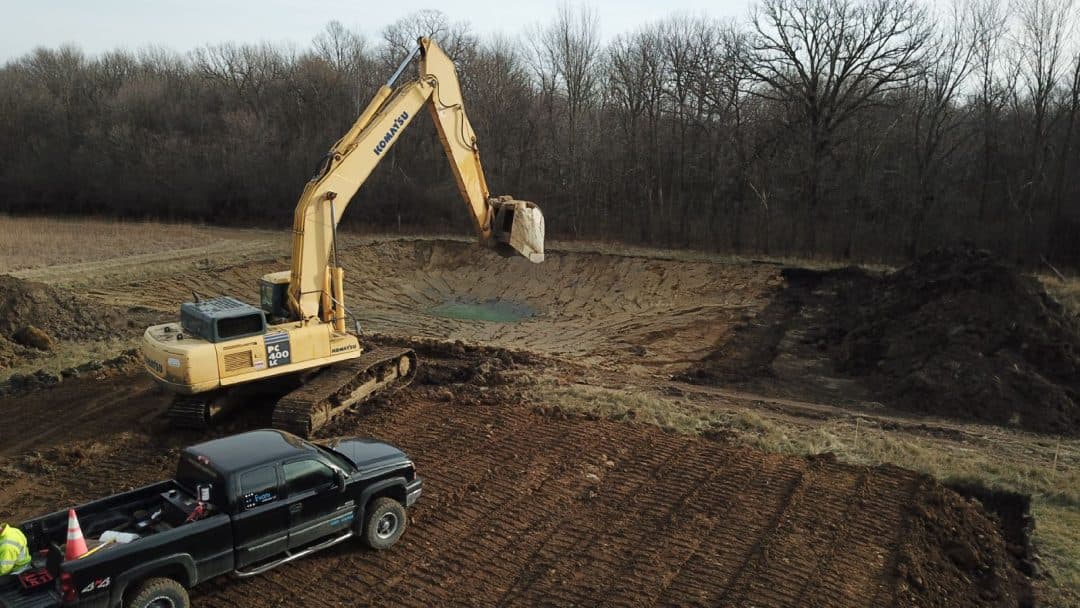
Property owners who want a pond on their land are usually thinking about the finished product — the water, the fish, the view from the house. The work that gets them there is earthwork, and the engineering that makes the pond hold water through summer droughts and survive spring floods without washing out is the same kind of earthwork Ward Excavation has been doing since 2001. Pond and dam construction is one of our original services and one of the most technically demanding.
The ponds we build serve three main purposes: farm ponds for livestock watering and irrigation, recreational ponds for fishing and swimming, and stormwater management ponds for controlling runoff on developed properties. Each type has different depth requirements, different bank slope specifications, and different overflow designs. A fishing pond needs depth to survive summer heat. A livestock pond needs gentle access grades so cattle can reach the water without eroding the bank. A stormwater pond needs engineered outlet capacity.
We build ponds across our 33-county service area. The two things that determine whether a particular site can support a pond are the clay content of the soil and the drainage area that feeds the pond. Both of those things we can evaluate during a site visit.
What makes a pond hold water
A pond holds water because of clay. Every pond that retains water year-round has a clay layer — either naturally present in the soil profile or built into the pond bottom and dam as an engineered component. Clay particles are small enough to interlock when compacted, forming a barrier that water cannot pass through at any meaningful rate. Sand and gravel, by contrast, drain freely. A pond excavated into pure sand will lose water as fast as it fills.
When good clay exists on site, the pond design uses it in place. The excavation exposes the clay layer and shapes the pond bowl within it. When the on-site soil is too sandy to hold water, clay has to be hauled in and placed as a liner — typically compacted in lifts across the pond bottom and keyed into the dam core. Whether clay is available on site or has to be imported is one of the largest variables in pond construction cost.
The dam — if one is needed — is the structure that impounds the water on the downhill side. Not all ponds have dams; a pond dug into flat ground below the water table fills from groundwater and does not need one. But a pond built across a drainage draw or a valley requires a dam, and the dam has to be engineered correctly. The core of an earthen dam is compacted clay, placed in lifts and keyed into the underlying clay stratum so water cannot seep under the dam. The outer slopes are typically built at three-to-one or gentler — three feet of horizontal run for every foot of vertical rise — to prevent slumping.
Freeboard is the vertical distance between the normal water level and the top of the dam. Freeboard exists so that storm events can temporarily raise the water level without overtopping the dam. Overtopping erodes the downstream face of the dam and can cause failure. The spillway — a pipe or constructed channel through the dam — is what prevents overtopping by discharging excess water in a controlled path when the pond level rises above the design mark. Spillway sizing depends on the drainage area feeding the pond and the expected storm intensity.
For regulated-size dams — those above the thresholds set by the NC Dam Safety Law or equivalent South Carolina regulations — a licensed dam engineer is required for design and construction oversight. Ward Excavation builds farm ponds and small recreational ponds where we handle the full scope. For dams that fall under state regulation, we perform the earthwork under the direction of a licensed dam engineer the property owner retains. We are clear about this boundary during the estimate so nobody is surprised about who is responsible for what.
What's included
New pond excavation
Digging a new pond from raw ground to the specified depth and shape. Includes clay identification, bank shaping, and spoil management. Depth is determined by intended use — fishing ponds need deeper water than livestock ponds.
Earthen dam construction
Building compacted clay-core dams to impound water. Includes core placement in lifts, slope construction, and freeboard establishment. Dam design follows standard earthen dam practices for the pond size.
Spillway installation
Installing pipe or channel spillways to discharge overflow water safely through the dam. Spillway sizing matches the drainage area and expected storm intensity to prevent overtopping.
Pond cleaning and deepening
Dredging and re-excavating existing ponds that have silted in over time. Silt removal restores water depth and volume. The silt — which is usually nutrient-rich topsoil — can often be spread on adjacent fields.
Bank and shoreline shaping
Grading pond banks to stable slopes, building access points for livestock or recreation, and shaping the shoreline for aesthetics and erosion resistance.
Stormwater pond construction
Building retention and detention ponds for stormwater management on developed properties. Stormwater ponds have specific outlet and overflow requirements that differ from farm or recreational ponds.
Pond repair
Fixing leaking dams, repairing eroded spillways, rebuilding washed-out banks, and addressing other structural problems with existing ponds. Leak diagnosis starts with determining whether the water is leaving through the dam, the bottom, or the spillway.
What to expect
- 1
Site evaluation
We walk the property, look at the topography and drainage, and assess the soil for clay content. This determines whether the site can support a pond and what type of construction is required.
- 2
Pond design and layout
We establish the pond size, depth, bank slopes, dam location (if needed), and spillway placement. On simple farm ponds, this happens during the estimate visit. On larger ponds, it may involve a separate site survey.
- 3
Clearing and excavation
The pond area is cleared of vegetation and topsoil. Excavation begins with the deepest section and works outward. Spoil material is used for dam construction or hauled off site.
- 4
Dam construction and compaction
If a dam is needed, clay core material is placed in lifts and compacted. The dam is built to the design height with the specified slope ratios and freeboard.
- 5
Spillway and overflow installation
The spillway pipe or channel is installed through the dam at the design elevation. Anti-seep collars are placed around the pipe to prevent water from tracking along the outside of the pipe through the dam.
- 6
Bank shaping and stabilization
Pond banks are shaped to the specified slope, compacted, and stabilized with seed or erosion control to prevent washout before vegetation establishes.
Questions homeowners ask
- What determines the cost of building a pond?
- The biggest variable is whether good clay exists on site or has to be hauled in. A pond dug into a site with a natural clay layer costs significantly less than one that requires imported clay for the bottom liner and dam core. After that, cost depends on the volume of earth moved (pond size and depth), whether a dam is needed, spillway complexity, and access. We evaluate the soil and topography during the site visit and give you a quote based on what the site actually requires.
- How do I know if my land has the right soil for a pond?
- The site visit answers this. We look at exposed soil in existing ditches, road cuts, or test holes and assess the clay content at pond depth. Dark, sticky, cohesive soil that holds together when squeezed is a good sign. Loose sand that falls apart is not. Where on-site clay is thin or absent, imported clay raises the construction cost.
- How deep should a pond be?
- It depends on the purpose. Fishing ponds in North Carolina generally need a deep zone of eight to ten feet minimum to keep water temperature low enough to prevent summer fish kills. Livestock watering ponds can be shallower — four to six feet is often sufficient. Decorative ponds and stormwater ponds have their own depth requirements based on function. We discuss depth during the design phase based on what the pond is for.
- Do I need a permit to build a pond?
- It depends on the pond size, water source, and location. Small farm ponds collecting surface runoff often do not need a permit. Ponds that impound a stream or exceed certain size thresholds may require review from the NC Division of Water Resources or the Army Corps of Engineers. We can advise during the estimate, but the property owner is responsible for obtaining permits.
- How long does it take to build a pond?
- A small farm pond without a dam typically takes three to five days. A larger pond with a dam, spillway, and bank shaping can take one to two weeks. Weather affects the schedule because clay compaction requires the right moisture content — too wet and it will not compact, too dry and it cracks.
- Can you fix a pond that is leaking?
- Usually, yes. Pond leaks happen through the dam, through the bottom, or around the spillway pipe. Diagnosing which path the water is taking is the first step. Dam leaks are fixed by rebuilding the clay core. Bottom leaks may require a clay blanket. Spillway leaks mean replacing the pipe and anti-seep collars. We assess the leak during a site visit and quote the specific repair.
- Do you build ponds outside Columbus County?
- We build ponds across our full 33-county service area. Pond construction pairs well with our other services — if we are already running equipment to a property for clearing or grading, adding a pond to the scope keeps mobilization cost down. Call (910) 981-1119 and tell us what you have in mind.
Permits and official resources
Official sources worth knowing before this kind of work starts. We handle the machine side; these are the agencies that govern the paperwork side.
Where we offer pond and dam building
Ward Excavation runs a 150-mile service radius from our Whiteville yard. Licensed and insured in North Carolina and South Carolina, we work pond and dam building jobs across the counties below and 25 more — from the Columbus County interior out to the Brunswick coast and across the line into Horry County, SC.
Jobs that go hand in hand with pond and dam building
Ready to start your project?
Family-run since 2001. Licensed and insured in NC and SC.