
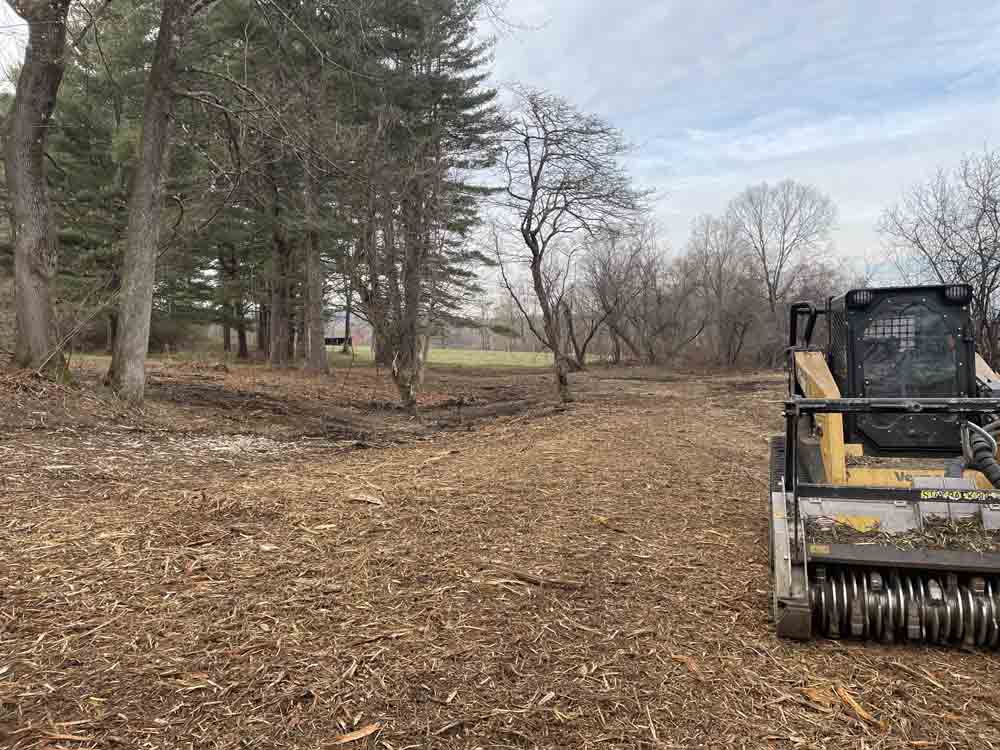
A drum mulcher drives into standing brush and small timber and comes out the other side leaving chipped organic material on the ground instead of bare dirt. No burn piles. No debris trucks. No exposed topsoil waiting to wash away in the next rain. That is forestry mulching, and it is one of the most requested services Ward Excavation runs across southeastern North Carolina.
Property owners call us for mulching when they want land cleared without the disruption and disposal cost of traditional push-and-pile methods. The typical mulching job is a residential lot with pine and understory that needs to become buildable ground, or an agricultural property where pasture has been invaded by saplings and brush over years of non-use. Fence lines, utility rights-of-way, and firebreaks are also common mulching jobs.
The mulcher works best on trees up to about twelve inches in diameter — anything larger than that generally needs to be felled conventionally before the mulcher comes through. That size limit is honest, not a weakness — the majority of clearing work in Columbus, Bladen, and Brunswick counties involves pine and scrub oak in that range, and the mulcher handles it in a single pass that traditional clearing would need three or four operations to match.
Why single-pass mulching beats traditional clearing
Traditional land clearing follows a sequence: fell the trees, push them into piles with a bulldozer, either burn the piles or load them onto trucks and haul them to a disposal site, then come back and grind the stumps as a separate operation. Each step takes equipment time, each step costs money, and by the end the ground surface has been scraped to bare mineral soil by dozer tracks. That bare soil erodes immediately — every rain event moves dirt off the site until ground cover re-establishes.
Forestry mulching collapses that sequence into one pass. The drum mulcher grinds standing trees, brush, and stumps into a two-to-four-inch layer of organic chips that stays on the ground. The mulch layer holds moisture, suppresses weed germination, slows runoff, and breaks down into the soil over time. There is no burn permitting involved, no disposal trucking cost, and no separate stump-grinding visit. For properties where bare soil is not required — which includes most residential lots, pasture reclamation, and utility corridors — mulching produces a better result at a lower cost.
Mulching has honest limits. It is not cost-effective for very large hardwood — oaks and sweetgums over twelve inches eat mulcher teeth and slow production to the point where conventional felling is faster. The mulch layer left behind can hide stumps at or just below ground level, which matters if the site is going to be graded for a foundation or paved — those stumps need to be found and grubbed out before construction starts. And cleared ground that was heavily wooded will produce regrowth from surviving root systems during the first growing season, so the property owner should plan for a follow-up pass or mowing regimen in year one. We explain all of this during the estimate so nobody is surprised after the mulcher leaves.
What's included
Residential lot mulching
Single-pass clearing of wooded lots for new home construction. The mulch layer stays on the ground and acts as erosion control until construction begins. Building footprint areas can be grubbed separately if needed.
Fence line and boundary clearing
Reclaiming overgrown fence lines, property boundaries, and field edges. Common on agricultural properties where tree lines have widened into the working field over years.
Pasture reclamation
Mulching saplings, brush, and invasive vegetation that has taken over former pasture or cropland. The mulch layer suppresses regrowth and adds organic matter back into the soil. Follow-up mowing in the first growing season keeps new growth in check.
Utility right-of-way clearing
Clearing vegetation along power line corridors, pipeline easements, and road rights-of-way. Mulching is preferred by many utility and DOT operations because it does not leave bare soil exposed to erosion.
Selective vegetation management
Targeted mulching that removes understory and specified trees while leaving mature hardwoods, specimen trees, or buffer zones intact. The operator navigates around preservation trees rather than pushing everything into a pile.
Firebreak creation
Mulching strips along property lines, access roads, or between wooded areas and structures to create defensible space. The mulched strip removes fuel load without leaving bare ground.
Storm debris mulching
Mulching downed limbs, toppled trees, and storm debris in place rather than hauling it off site. Faster and less expensive than truck-and-haul cleanup after a hurricane or ice storm.
What to expect
- 1
Property walk and vegetation survey
We walk the site, note the tree species and sizes, identify any timber too large for the mulcher, and mark trees the owner wants preserved.
- 2
Access and staging plan
The mulcher needs a clear entry path. We identify the staging area and the route the machine will follow through the property to minimize ground disturbance.
- 3
Mulching pass
The drum mulcher works through the marked area in systematic passes, grinding standing trees, brush, and surface stumps into chips. Larger trees that were pre-felled get mulched where they fell.
- 4
Stump check
After the mulching pass, we walk the cleared area and check for stumps that the mulch layer is hiding. If the site is going to be graded or built on, hidden stumps get flagged for grubbing.
- 5
Final walkthrough
We walk the cleared area with the property owner, confirm the coverage matches the plan, and discuss regrowth expectations for the first year.
Questions homeowners ask
- What is forestry mulching exactly?
- A forestry mulcher is a machine — typically a tracked skid steer or dedicated carrier — fitted with a rotating drum studded with carbide cutting teeth. The drum spins at high speed and grinds standing trees, brush, and surface stumps into wood chips in a single pass. The chips fall to the ground and form a natural mulch layer two to four inches deep. The machine drives through the vegetation and leaves cleared, mulched ground behind it. No separate felling, piling, burning, or hauling step is needed.
- What drives the cost of forestry mulching?
- Tree size and density are the primary drivers. A property with scattered pine saplings and light underbrush mulches quickly — the machine moves at a steady pace without stopping. Dense mixed hardwood with twelve-inch trunks and heavy undergrowth slows production significantly because the drum has to work harder and the operator makes multiple passes. Terrain matters too — slopes, wet ground, and poor access add time. We walk the property, assess the vegetation, and quote based on what the mulcher will actually encounter rather than applying a flat per-acre number.
- What size trees can the mulcher handle?
- Trees up to about twelve inches in diameter go through the drum efficiently. Larger trees can technically be mulched but the production rate drops and tooth wear increases to the point where it is more cost-effective to fell them conventionally and mulch the slash. On most jobs, trees over the twelve-inch threshold get cut by a saw or pushed by a dozer first, then the mulcher comes through and processes the remaining material.
- Does mulching remove the stumps?
- The drum grinds stumps flush with or slightly below ground level — typically two to four inches below the surface. This is sufficient for pasture, landscaping, and most residential lot prep. It is not sufficient for a building pad or driveway sub-base, where stumps need to come out entirely. If the site requires full stump removal below the mulching depth, we grub those areas separately with an excavator.
- How long does mulching take compared to traditional clearing?
- Mulching is faster because the fell, pile, burn-or-haul, and stump-grind steps collapse into one operation. A one-acre pine lot with moderate density usually mulches in a day. How much faster that is compared to traditional clearing depends on the tree size, the density, and how much of the site can be mulched versus grubbed — the on-site estimate gives the honest comparison for your specific property.
- Will the vegetation grow back after mulching?
- Some regrowth from surviving root systems is normal during the first growing season, especially from hardwood species that stump-sprout aggressively. The mulch layer slows regrowth significantly compared to bare soil, but it does not eliminate it entirely. Most property owners plan to mow or re-mulch once during the first year to keep regrowth in check. After that first year, regrowth pressure drops sharply as the root systems exhaust their energy reserves.
- Do you mulch land outside Columbus County?
- We run mulching jobs across our full 33-county service area in southeastern North Carolina and the Pee Dee region of South Carolina. The mulcher travels on the same lowboy trailer as our other equipment, so it goes wherever the rest of our machines go. Call (910) 981-1119 and tell us where the property is.
Permits and official resources
Official sources worth knowing before this kind of work starts. We handle the machine side; these are the agencies that govern the paperwork side.
Where we offer forestry mulching
Ward Excavation runs a 150-mile service radius from our Whiteville yard. Licensed and insured in North Carolina and South Carolina, we work forestry mulching jobs across the counties below and 25 more — from the Columbus County interior out to the Brunswick coast and across the line into Horry County, SC.
Jobs that go hand in hand with forestry mulching
Ready to start your project?
Family-run since 2001. Licensed and insured in NC and SC.